Resource Curse
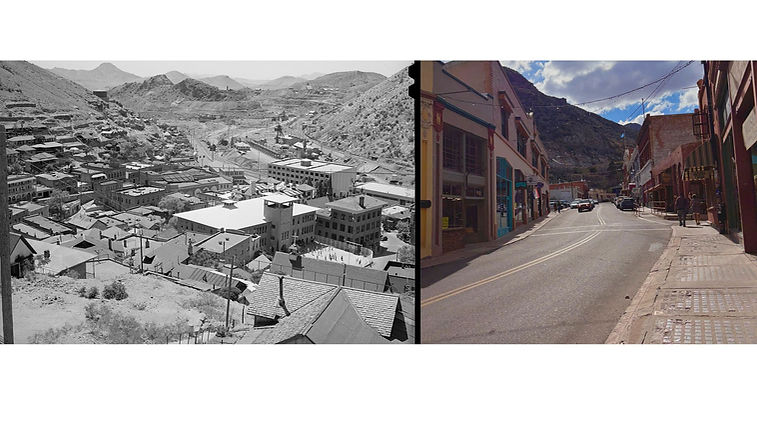
The Bisbee Effect
Looking Down on Bisbee, Arizona from US Office of War, 1944. Public Domain.
Image courtesy of Mikayla Lemon.
Located in Southern Arizona, Bisbee experienced a boom in the late 19th and early 20th centuries due to its rich mineral deposits, particularly copper. The mining industry became the lifeblood of the town, attracting thousands of workers and generating substantial wealth for mining companies.
However, as with many resource-dependent economies, Bisbee faced several consequences of the resource curse:
-
Economic Vulnerability: Bisbee's economy became heavily dependent on copper mining, neglecting the development of other industries. When copper prices fluctuated or when the mines started to deplete, Bisbee experienced economic downturns, leading to job losses, business closures, and population decline.
-
Boom and Bust Cycles: The cyclical nature of the mining industry subjected Bisbee to boom and bust cycles. During periods of high demand and high prices, the town prospered, but during downturns, it suffered from unemployment and poverty.
-
Environmental Degradation: The intensive mining activities in Bisbee led to significant environmental degradation, including soil and water pollution, deforestation, and landscape alteration. These environmental impacts not only harmed the local ecosystem but also posed health risks to residents.
-
Social Disruption: The dominance of the mining industry in Bisbee created social tensions and inequalities. Mining companies wielded significant power and influence, often at the expense of workers' rights and local communities. Labor disputes, strikes, and conflicts between workers and management were common occurrences.
-
Legacy of Abandonment: As the mines in Bisbee became less profitable and eventually closed, the town faced the challenge of dealing with abandoned mines, polluted sites, and derelict infrastructure. The legacy of mining left behind environmental liabilities and economic hardships for future generations to address.
Despite these challenges, Bisbee's story also highlights resilience and adaptation. In recent decades, the town has diversified its economy by promoting tourism, arts, and culture. The well-preserved infrastructure, picturesque surroundings, affordable housing, and nearly ideal climate helped attract an arts culture and has attracted visitors and new residents, contributing to its revitalization.
.jpg)
Reasons Bisbee Thrived
Cheap And Well-Preserved Infrastructure
When the mines were closed in the early 1970s, the town had a well-preserved physical infrastructure (including hotels, churches, saloons, opera house, library and downtown stores).
Private Property Ownership
The fact that Bisbee is not a "company town" (meaning the mining company did not own the homes and businesses in town) enabled newcomers with modest wealth to purchase properties directly from private citizens.
Community Cultural Tolerance
Bisbee was a racially diverse and culturally-rich area, which supported the arts community and tolerated recreational drug use, alcoholic consumption and alternative lifestyles.
Cheap Housing Stock
As miners left Bisbee for other opportunities, they sold their home at a discounted rate, providing opportunities for newcomers to own properties for only few thousand dollars.
Ideal Climate
The nearly ideal climate (with little rain, snow or extreme temperature) both preserved the infrastructure and attracted newcomers to the area.
Artist Pioneeers
After the miners moved out, there was a group of young and talented artists that paved the way for the arrival of a creative class that would follow.